

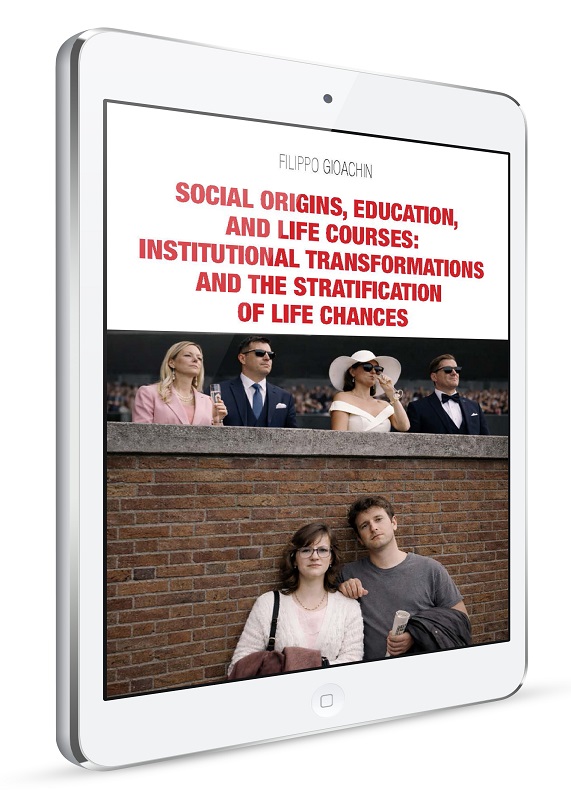
This book examines how recent institutional and structural transformations—educational expansion, production restructuring, global competition, and labour-market reforms—have reshaped inequality of opportunity by setting the incentives and constraints within which families transmit resources, thereby generating differentiated life-course outcomes.
Four empirical studies develop this contribution. First, for Italy, sibling-correlation estimates in education document a persistent influence of family background and marked regional disparities. Second, for Denmark, Germany, and the United States, sibling correlations in income volatility across the life cycle show that not only levels of attainment but also instability and exposure to risk are transmitted across generations, in ways that vary with welfare-state protection. Third, a comparison of Italy and Germany investigates the consequences of precarious labour-market entry, demonstrating that early-career trajectories diverge systematically by parental resources, and that insecure starts can amplify origin-related gaps. Fourth, a factorial survey experiment in the UK hiring context reveals that social-status signals affect recruiters’ decisions and intersect with gender and parenthood, reinforcing inequality.
Overall, this work argues that contemporary life-course risks and transitions also play a central role in stratifying opportunities. The influence of social origin is not fading away; rather, it is adapting to new contexts by shifting the channels through which inequality is reproduced.
DATI BIBLIOGRAFICI
Autore: Filippo Gioachin
Editore: Ledizioni
Collana: Interventi
Pubblicato in: marzo 2026
Lingua: inglese
Formato: PDF in OA
ISBN: 9791256007363



Recensioni
Ancora non ci sono recensioni.